Critical Thinking with Confidence
Question everything (including this blog post)

Picture this: You're sitting in seminar, and something the prof just said doesn't sit right. It contradicts everything you've witnessed in your community, your workplace, your life. But instead of speaking up, you write it down dutifully, assuming you must be wrong.
After all, they're the “expert.” You're…”just” a student.
Except...
…what if that unsettled feeling in your gut is exactly what critical thinking feels like?
What if you've been doing it all along, but nobody told you it counted?
The feedback that keeps us up at night
"Needs more critical analysis."
"Go deeper."
"Engage more critically with the material."
Sound familiar? These comments appear on essays persistently, leaving us wondering:
But HOW?
What does that even mean?
Am I supposed to tear everything apart?
Disagree with everything?
Use fancier words?
Here's what nobody tells you:
That moment when a theory doesn't match your reality? → That's critical thinking.
That question forming in the back of your mind during lecture? → Critical thinking.
That "but wait..." feeling when you notice whose voices are missing from the discussion? → Critical thinking.
Why don’t we trust our critical instinct
Let's get real about what's actually happening when you doubt your analytical abilities:
The Authority Trap
We've been taught that knowledge flows one way: from expert to student. Your observations? Your lived experience? Somehow they don't feel "academic enough."
The Perfectionism Paralysis
We think critical thinking means having the perfect counterargument, the flawless critique, the unassailable position. (It doesn't.)
The Imposter Voice
"Who am I to question this established author/theory/renowned scholar/peer-reviewed article?"
The Cynicism Confusion
We think being critical means being negative, tearing things down, finding flaws in everything. (It's actually about genuine curiosity, not cynical dismissal.)
Here's your permission slip: Your questions are valid. Your observations count. Your lived experience interrogating the theory—that's critical thinking.
Reframing what critical thinking is all about
ABeing the “smartest” person in the room (whatever that means)
Finding flaws just to seem intelligent
Having all the answers
Dismissing everything cynically
Using academic jargon to sound sophisticated
It's actually about:
Being genuinely finding interest in how things work
Wondering why certain voices are missing
Noticing when evidence doesn't quite support the conclusion
Asking "what if?" and "why?" and "says who?"
Holding ideas up to the light to see them better
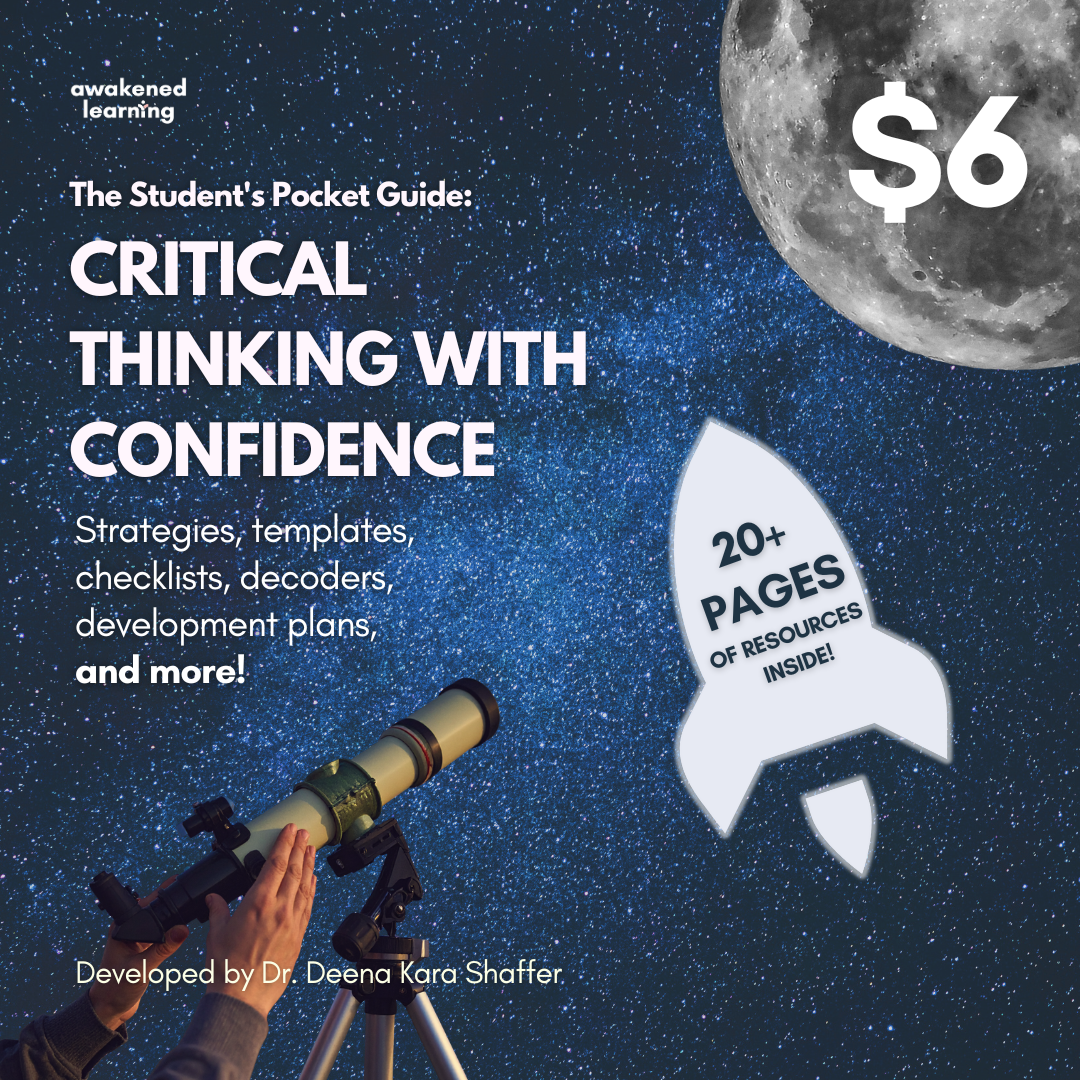
Strengthen your critical thinking with this 22-page guide that turns academic analysis into clear, simple, confidence-building steps. Designed for students who want practical tools they can implement right away, this resource is straightforward, easy to follow, and ready to be used. Develop your critical thinking skills so you can take in information and share your thoughts in written and verbal formats while feeling confident and at ease.
What’s inside…
✓ Frameworks for developing your opinions
✓ Guides for putting your thoughts into structured analysis
✓ Tips for expanding beyond summary
✓ Multi-Highlighter System for visible, structured thinking
✓ Sentence starters for discussions and written work
✓ Detailed checklists
✓ Discipline specific tips for Science, Social Sciences, Humanities, and Professional Studies
✓ 4-week skill-building plan
✓ Emergency templates for essays and quick assignments
✓ Professor feedback decoder
✓ Confidence boosters for tough moments
And a whole lot more!
4 angels of critical thinking
Think of critical thinking like taking photos of an idea from different angles. You don't need all four every time, but knowing your options gives you power:
1. Zoom Out (The Context Check)
Who created this and why?
Who benefits from this perspective?
What was happening in the world when this was written?
What conversation is this part of?
2. Zoom In (The Detail Detective)
What evidence is actually here?
What assumptions are being made?
How does the logic flow (or not)?
What's being claimed vs. what's being proven?
3. Look Sideways (The Perspective Shift)
Who might disagree and why?
Whose voices are missing?
What would this look like from another cultural lens?
What's the opposite argument?
4. Look Inward (The Honest Mirror)
Why do I want to believe this (or not)?
What are my own biases here?
What don't I know that I need to know?
How is my experience shaping my interpretation?
Meet Marcus: "I used to freeze when asked for my 'critical analysis.' Now I just pick an angle and start there. Usually 'Look Sideways'—I imagine how my grandmother would respond to this theory. It works every time."
The questions that can save your essays
When you're staring at your notes thinking "I'm just retelling, not analyzing," try these:
So what? (Why does this matter?)
Now what? (What are the implications?)
Compared to what? (How does this relate to other ideas?)
According to what? (What's the foundation here?)
But what about...? (What contradicts this?)
What's missing? (What gaps exist?)
These aren't just questions, they're bridges from summary to analysis.
The Multi-Highlighter Method
Grab three different coloured highlighters:
Colour 1 (Green): Main arguments/claims—the "what"
Colour 2 (Yellow): Evidence/support—the "how they know"
Colour 3 (Pink): Your questions/reactions—the "but wait..."
Now look at your pages. See all that pink? That's your critical thinking, made visible. Those are your essay points, your discussion contributions, your unique perspective.
Two week overhaul program
Week 1: Build Awareness
Notice overwhelm signals
Track when they appear
Document what triggers them
Practice 2-minute stops
Week 2: Build Systems
Create a Sunday planning ritual
Practice academic discernment
Set daily study containers
Establish sleep boundaries
Reflection questions to try
Where does overwhelm typically ambush your learner?
What systems could prevent next week's overwhelm?
How can you model overwhelm prevention?
The Both/And Approach
Academic culture loves binaries: right/wrong, agree/disagree, valid/invalid.
But critical thinking lives in the "both/and":
This theory explains X well AND overlooks Y
This research is groundbreaking AND has limitations
This argument is compelling AND makes assumptions about Z
You can analyze your favourite film and still love it. You can question a theory and still find it useful. You can critique an idea and still respect its contribution.
Critical thinking in action
The Experience Check: "This framework assumes everyone has equal access to resources, but in my community..."
The Source Scan: "Interesting claim. Is this their opinion? Research? Experience? Something they heard?"
The Perspective Flip: "This urban development is called 'successful,' but successful for whom?"
The Time Machine: "This was written in 1950. What wasn't known then? What couldn't be said?"
The Connection Web: "This reminds me of [other theory/experience/observation]. What happens when I put them in conversation?"
Three step plan for critical thinking
This Week:
Pick one reading
Use the multi-highlighter method
Generate three "___what?" questions
Share ONE question in class (start small!)
This Month:
Practice one "angle" per week
Notice when you're already thinking critically
Write down your "but wait..." moments
Start trusting your observations
This Semester:
Develop your unique critical thinking style
Stop apologizing for your questions
Bring your whole self to your analysis
Watch your confidence grow
When critical thinking starts to feel uncomfortable
Critical thinking can feel destabilizing. It can:
Challenge beliefs you've held forever
Reveal complexity where you wanted simplicity
Show that institutions you trusted have flaws
Make you realize you've been wrong about things
This discomfort isn't failure—it's growth. It's your brain literally forming new neural pathways. It's you becoming a more complex thinker in a complex world.